
FW Tools
Start
Pricing
Deutsch
Open the tool
Stopwatch, notepad and camera in one hand — and three things in the evening that nobody can put back together. This tool brings them together: one press writes a time, a photo lands at its place on the timeline, and at the end there is a report.
Rescue from below and from above, fall protection. Shaft, excavation, tank, silo, training tower — wherever an exercise runs in phases and the phases have times.
One press on a large target writes the timestamp — at the moment it happens, not from memory in the evening. Big enough to hit without looking, with a double-tap guard.
Taken from within the page, on the timeline at the minute they were made — not where the file dialog finally came back.
“Start to first contact with the casualty”, “1st rescuer to ready for transport”. They show where the time went, not just that it went.
Edge and shaft record separately; afterwards both logs are merged into one — with the clock offset set by hand, because two phones rarely agree.
Open it once where there is reception. After that everything works down the shaft: recording, photographing, reviewing, producing the report.
Target times per mark, deviation in the review, and a comparison across all teams and stations of a rope rescue award.
Marks can be added, renamed and deleted; an adjusted preparation is saved as your own template and passed on to the other assessors.
A record, not a monitoring system. No breathing-apparatus monitoring, no safety function for the crew down the shaft. Nothing on which life depends directly may hang on a browser window staying open.
Four views on the phone — that is where the tool is used, not at a desk.
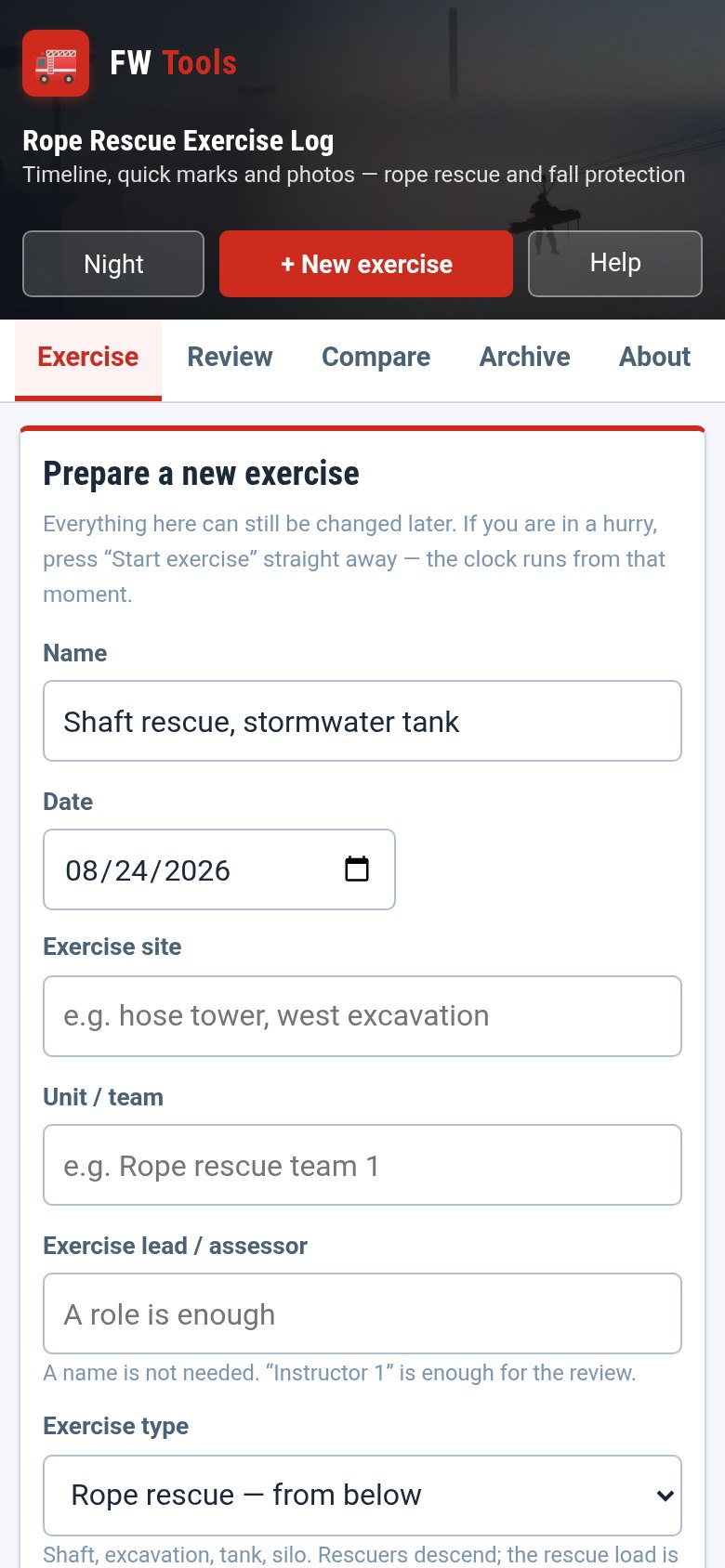
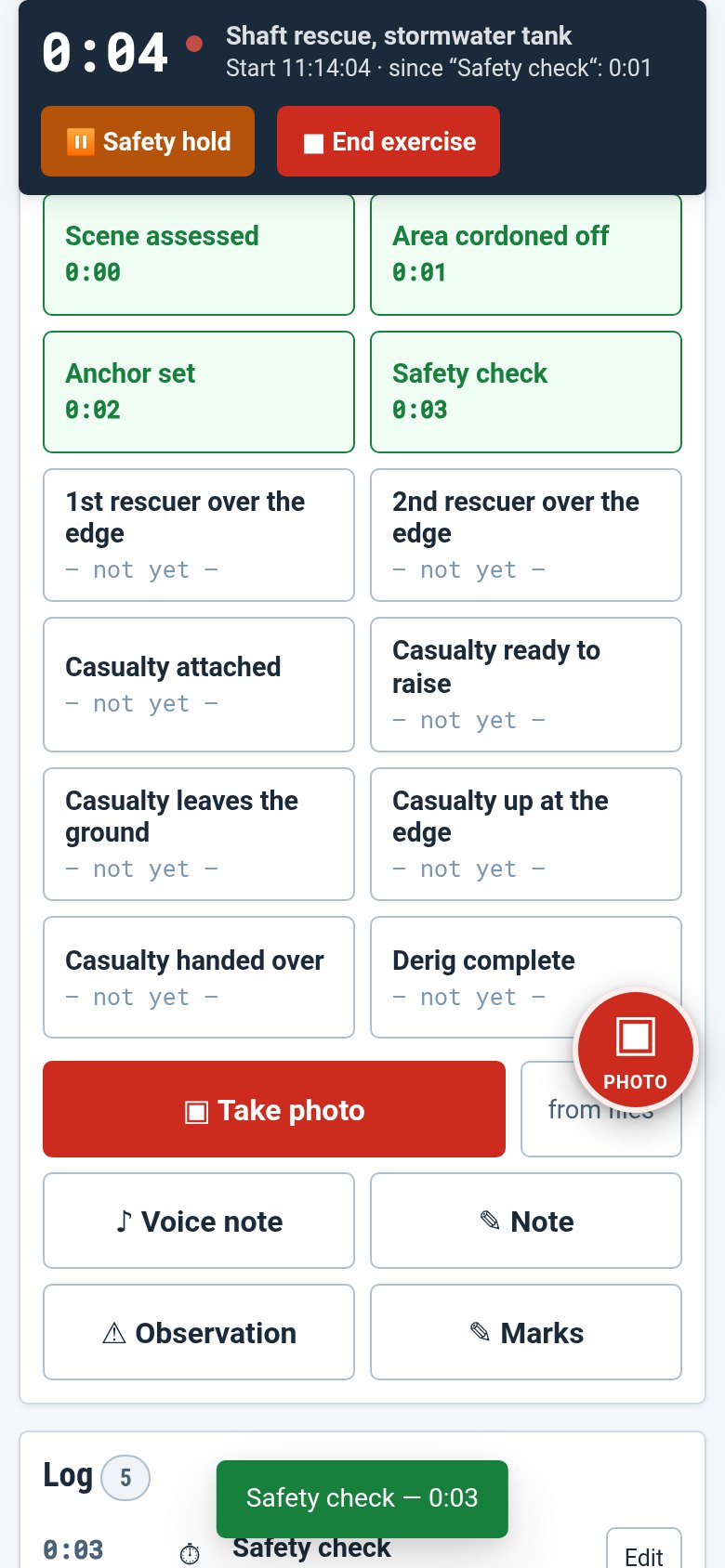
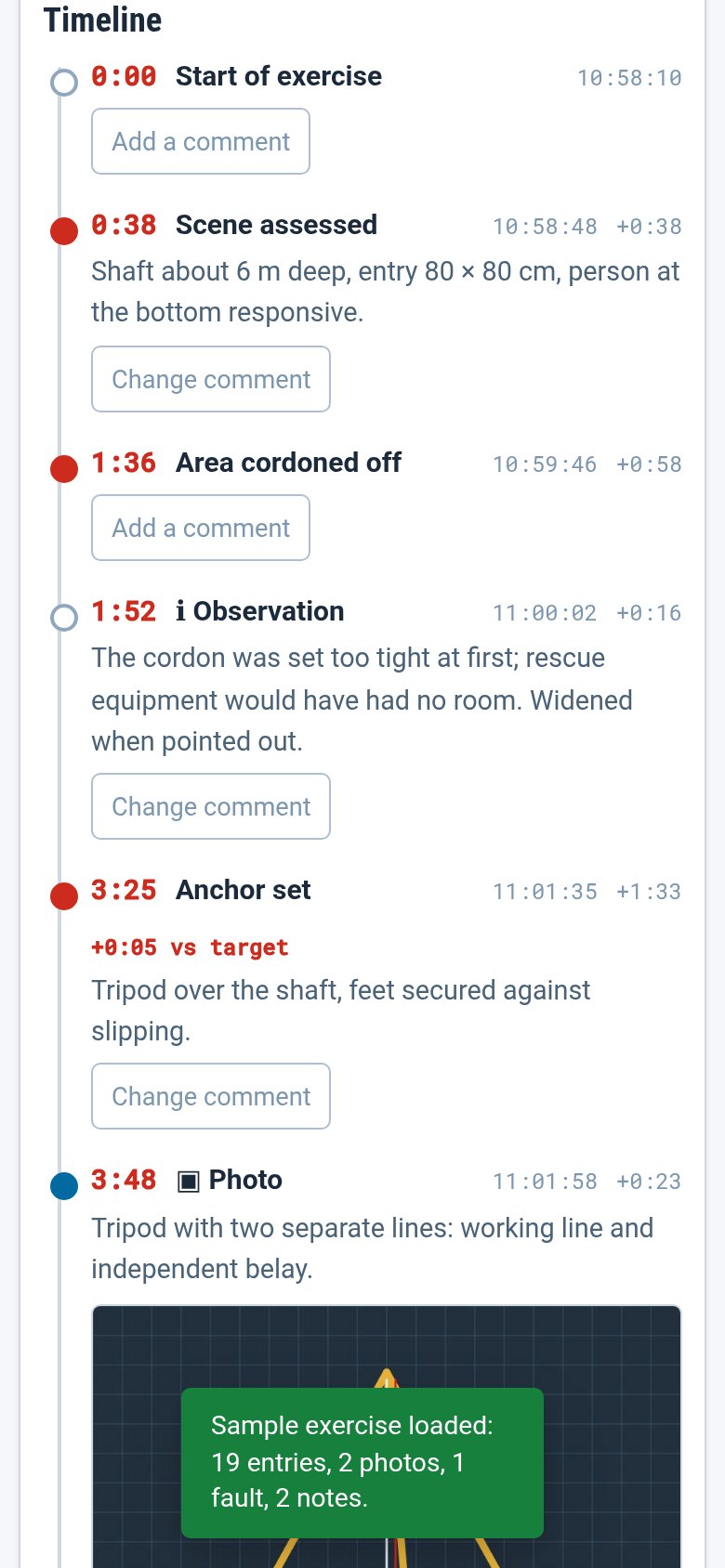
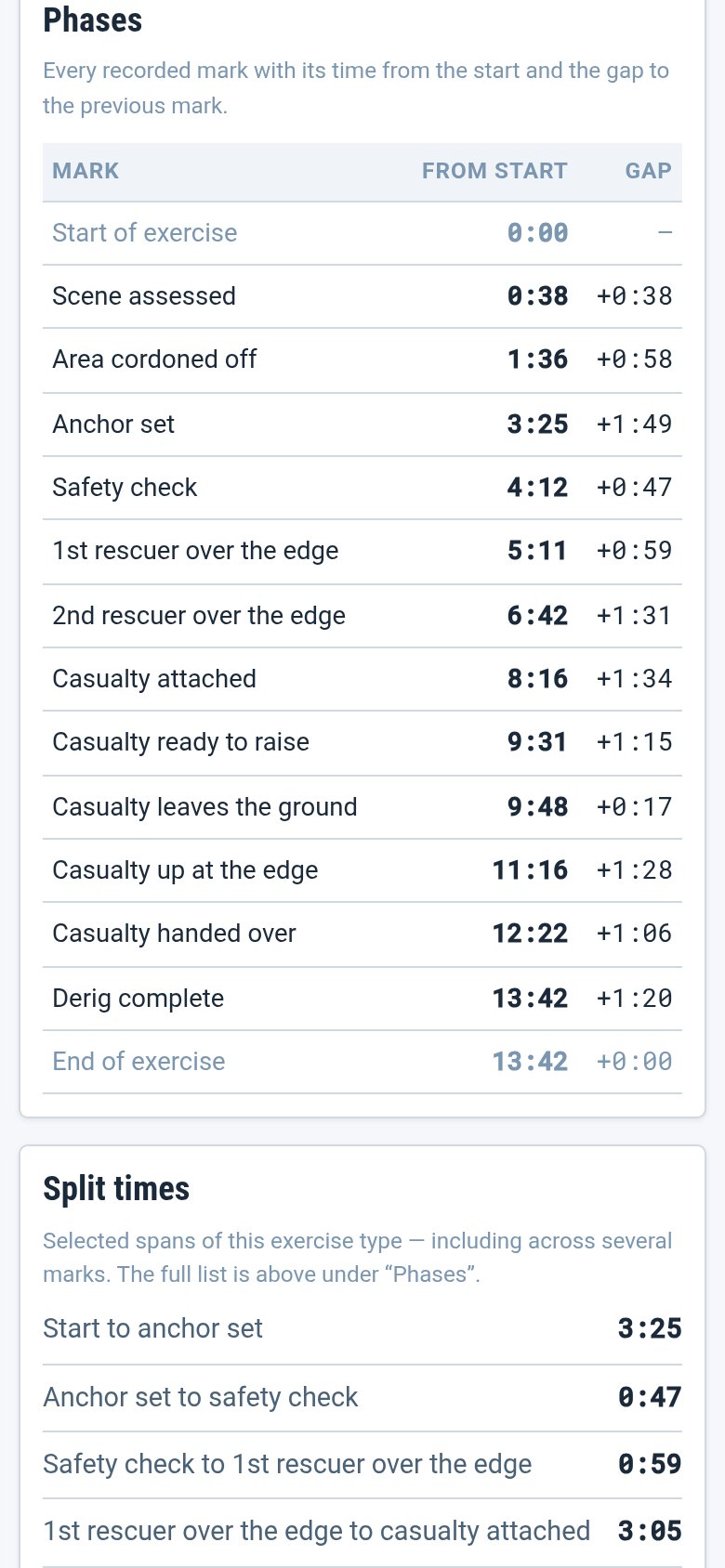
The finished document is the PDF: set on the server, so that the sheet looks the same everywhere — with timeline, split times, photos and confirmation sheet.
The brigade can store its own letterhead as a PDF. It is placed underneath every page — the brigade’s header, logo and footer, plus an adjustable text area so that the text does not run into the letterhead. It is stored once on the start page and then applies to every tool in this browser.
On the shared installation the file stays in the brigade’s browser and is sent along only for the individual print job; it is not stored there. A self-hosted installation can instead keep its letterhead permanently on the server.
Today the PDF is produced without a key too — as a sample print, watermarked and without the confirmation sheet. In a coming version the PDF output as a whole will be reserved for the licence.
What stays free: recording, reviewing, comparing and the complete backup in the archive — the recording itself belongs to the brigade and can be taken off the device at any time. The finished document, ready for signature, is then the service the licence stands for.
The date is not fixed yet; the change will be announced here and in the changelog beforehand. Anyone who already holds an instructor licence will notice nothing.
Recording, reviewing, comparing and backing up work without a key. Without an activated key the PDF is produced as a sample print, watermarked and without the confirmation sheet.
The instructor licence (€199 a year) unlocks the performance record and the Rope Rescue Exercise Log together — not per tool, not per person, but for the whole instructor group. Whoever teaches both pays once.
It covers both tools in every respect — including the PDF output, once that comes fully under the licence (see above).
In the browser, nowhere else. No account, no sign-in, no upload. The way to another device is a file that you pass on yourself.
One exception, and it is your decision: pressing Create PDF sends the log of that one run to the server, which sets the document and returns it. Nothing is stored there. Anyone who does not want even that does without the PDF; the recording itself never leaves the device.
The browser storage is the only copy. After a day that counts, the backup in the archive is part of the routine — as much a matter of course as making the kit ready again.
The rope rescue part of this tool was developed substantially with Axel Manz. The exercise types, the quick marks and the sequences the timing follows come from rope rescue practice.
No sign-in, no account. Create a test exercise, press three marks, end it, produce the report — four minutes.